The Living Traditions

Culture & Traditions

Faith, family, art and adornment, woven into the daily and ceremonial life of the Urhobo people. These are living traditions, carried in how we marry, dress, sing, eat and honour one another.

A Living Culture

How the Urhobo Live and Celebrate

Urhobo culture is not a museum piece. It is practised today, in homes and town halls across Delta State and the diaspora.

Much of it is bound to the rivers, creeks and farmland of the western Niger Delta: a faith that honours the Creator and the ancestors, a marriage custom that treasures the daughter, an art of satirical song that corrects the community with wit, and a dress of George cloth and coral beads that announces status and occasion. Customs vary from one kingdom to another, so the descriptions here give the shared patterns and note where practice differs or where sources disagree.

Cultural Signatures

Supreme Being
Oghene, the Creator, worshipped directly
Soul & realms
Erhi (soul), Erivwin (ancestors), Ugboma (body)
Signature art
Udje, the satirical song-and-dance of rival quarters
Bride price
Deliberately symbolic, commonly cited as 120 Naira
Iconic dish
Starch (usi) with banga soup
Iconic dress
George wrappers with coral beads
Faith, Cosmology & the Ancestors

Oghene, the Ancestors and the Unseen

A worldview in which the Creator, the divinities and the departed remain present in daily life.

Traditional Urhobo religion centres on Oghene, the supreme Creator, associated with the sky and worshipped directly rather than held at a distance. Around Oghene stand lesser divinities, the edjo and erhan, and above all the veneration of ancestors, honoured as active custodians of family morality and community welfare through rites, libations and festival.

Urhobo cosmology distinguishes the visible from the invisible. It names Erivwin, the realm of the spirit and the ancestors; Erhi, the individual soul; and Ugboma, the bodily, material life. Many tales, taboos and rituals point to rivers, creeks and water spirits, carrying practical knowledge of seasonal fishing, sacred groves and places to avoid, so that belief and ecology travel together. These water spirits are honoured in the great festivals, which belong to the Festivals pillar of this archive.

The indigenous Igbe movement also arose among the Urhobo. Today the large majority of Urhobo identify as Christian, across Catholic, Anglican, Pentecostal and evangelical communities, while honour for the ancestors remains culturally significant, and the two often live side by side within one family.

Marriage

A Union of Two Families

Urhobo marriage joins families, not only individuals, and unfolds in stages from first visit to celebration.

1. Introduction

The suitor makes his intentions known and is formally introduced, bringing his relations to the bride's family.

2. Investigation

Both families enquire into each other's character and standing before matters proceed.

3. List & acceptance

The bride's family presents a list, from outfits and drinks to the money to cook the bridal meal, and the suitor responds.

4. Bride price

A deliberately low, symbolic dowry is settled, commonly cited as 120 Naira.

5. Traditional wedding

The public celebration, rich in George cloth, music, the prayers of elders and dance.

The hallmark of Urhobo marriage is that symbolic bride price. After the 120 Naira is paid, a portion is returned to the couple to be invested and to grow over the marriage. Sources differ on the exact amount returned, with accounts citing both 10 and 20 Naira, but the meaning is constant: a daughter is honoured, and she is never for sale. The lists, the order of stages and the relatives involved vary by kingdom and by family, so this is the common pattern rather than a single canonical rite.

Attire & Adornment

Cloth, Coral and Ceremony

Urhobo dress is colourful and richly accessorised, and it speaks of status, occasion and readiness.

Urhobo monarchs in full regalia with coral beads and George wrappers
Urhobo monarchs in full regalia: coral beads, George wrappers and royal staffs.

Men's ceremonial attire is commonly built around a wrapper of about six yards, a shirt, and the Eru hat, frequently in George fabric, completed with coral beads at the neck and wrist, a walking stick and a horsetail. Women wear a pair of wrappers: the inner Aniku of about two yards and the outer Oseba of about four, with the Ewu blouse, a head tie known as Onerho or Uriofo, and, for the senior woman and the bride, the beaded crown called Okuku.

Coral beads at neck, wrist and waist signal wealth, status and ceremonial readiness, and the Ada staff marks a chief. Blue and yellow are often named as favoured colours, blue for the tribe's waters and skies and yellow for richness, though this colour symbolism comes from popular and fashion sources and is best read as cultural interpretation rather than fixed doctrine.
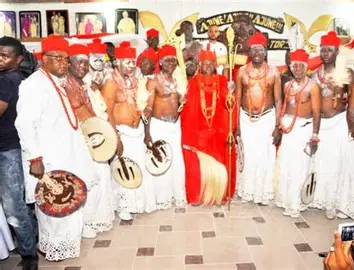
Urhobo Social Club members in chieftaincy regalia with the Ohworode of Olomu
Urhobo Social Club members in chieftaincy regalia, honoured by the late Ohworode of Olomu Kingdom, HRM (Dr) Richard Ogbon, OON, Ogoni-Oghoro I, in January 2017.
A Living Link

The Club and the Throne

This regalia is not only history. In January 2017 the late Ohworode of Olomu Kingdom, HRM (Dr) Richard Ogbon, OON, Ogoni-Oghoro I, conferred chieftaincy titles on nine members of the Urhobo Social Club, a living link between the club and the traditional institutions of Urhoboland.

Those honoured were the late Chief Johnson Barovbe, Chief Simeon Ohwofa, Chief (Engr) Godwin Onabedje, Chief Bright Apinoko, Chief Dan Oghoyone, Chief Edore Agba, the late Chief Jitobo Akanike, Chief Samson Okuesa and Chief Austin Tadafe.
Music, Dance & the Udje Art

Songs That Correct and Delight

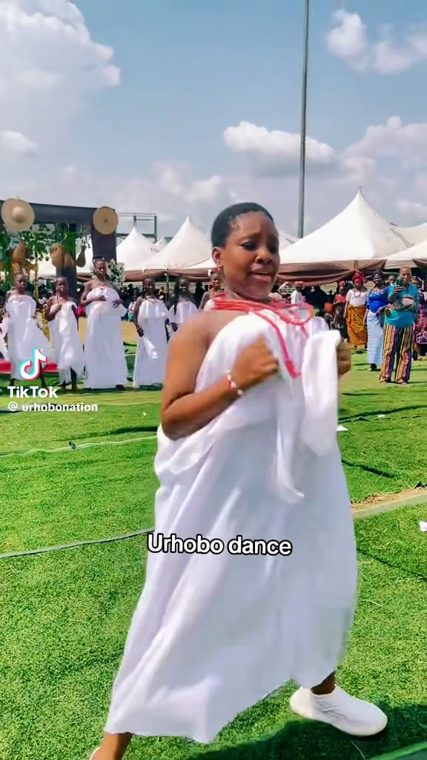
Urhobo musical life ranges from vigorous forms such as Udje, Ikpeba and Opiri to the more graceful Ikenike, with musicians expected to be skilled across many drums, among them the Ema, and poetic in composition. The communal Abigbo dance is performed at gatherings and celebration.

The most celebrated form is Udje, an integrated performance of song and dance by costumed performers at seasonal festivals. Rival quarters or towns compose songs about one another, often exaggerated and satirical, and perform them on an appointed day. As the scholar Tanure Ojaide records, Udje belongs to the art of satire: it attacks what the community counts as vice and aims at correction through wounding words, a means of curbing arrogance and greed. The tradition is also the subject of G. G. Darah's study, Battles of Songs.

Udje songs attack what society regards as vices and aim at correction and deterrence.After Tanure Ojaide, on the Udje tradition

Alongside song, Urhobo verbal art carries history and morality in folktales, proverbs and taboos, many of them tied to rivers and water spirits. Specific Urhobo folktale cycles and named trickster figures were not well documented in the reputable sources reviewed here, and this is a part of the collection we hope to deepen.

Urhobo dancers performing in traditional dress
Urhobo dance in performance. See more in the Media Gallery.
Everyday Traditions

Elders, Kin and the Naming of a Child

Beyond ceremony, custom shapes the ordinary rhythms of respect, community and belonging.

Respect for Elders

Respect for elders is foundational. Greetings, posture, the order of speaking in a gathering and the use of honorifics all express it, reflecting a gerontocratic order in which age and knowledge of custom carry authority.

Communal Life & Age-Grades

Communities organise into quarters and family compounds, with age-grade societies and town development unions sharing duties and labour. The Urhobo Social Club is itself an urban and diaspora expression of this communal tradition.

Naming & Birth

Children are named in ceremonies attended by the extended family, and names often carry meaning drawn from the circumstances of birth, the ancestors or the family's hopes for the child.

Cuisine

From River and Forest to the Table

Urhobo food is distinctive and palm-rich, shaped by a homeland of rivers, creeks and farmland.

The Iconic Dish

Starch, known as usi, served with banga soup is the dish most associated with the Urhobo table.

Soups & Staples

Owho soup is widely loved, and palm-based dishes are central. Eba and ogbono are eaten too, though these are common across many Nigerian peoples rather than uniquely Urhobo.

River & Forest

Fish and bushmeat feature strongly, especially in the coastal kingdoms, reflecting a life lived among creeks, lagoons and farmland.

Carry the Heritage Forward

The Urhobo Social Club Lagos preserves our culture and invests in our people. Join us, or support the building of Urhobo House.

About this page

This summary of Urhobo culture is compiled from public encyclopedic, scholarly and Nigerian community sources, including Wikipedia, Omniglot, Pulse Nigeria, Historical Nigeria, the writings of Tanure Ojaide and G. G. Darah, and the Urhobo Historical Society. The account of the Urhobo Social Club chieftaincy titles draws on Urhobo Today (2017). Customs vary from kingdom to kingdom, and figures such as the bride-price amount and the colour symbolism of attire are reported differently by different sources and are flagged in the text. Corrections and contributions from the community are warmly welcomed through our Contact page.