Kingdoms & Institutions

A Federation of Thrones

Urhoboland is not one kingdom but many: a confederation of co-equal, largely autonomous polities, each under its own traditional ruler, none set above the rest. This is how the thrones, the councils and the elders order Urhobo life.

The Federation

Many Thrones, One People

Ask how Urhoboland is governed and the answer begins with a correction: there is no single Urhobo kingdom, and no paramount ruler over the whole nation.

In the historian Peter Ekeh's phrase, Urhoboland is a confederation of co-equal, largely autonomous polities, each under its own traditional ruler. Every kingdom keeps its own throne, its own council and its own customs, and none answers to another. Authority in this federation has two homes: at the kingdom level the Ovie, the king, with his council of titled chiefs; at the level of town and village an older order of elders, led by the community's oldest man. The chapters below take each in turn, then the question every visitor asks, how many kingdoms there are, and the thrones as they stand today.

The Kingdoms at a Glance

Polities
Commonly counted as 22 to 24 cultural units; see below
Royal title
Ovie in most kingdoms, with local variants
The council
The Ovie-in-Council of titled chiefs
Community head
The Okpako Orere, the eldest man
The Throne

The Ovie

In most Urhobo kingdoms the ruler bears the title Ovie. He stands at the head of the kingdom's indigenous government, carrying its highest traditional authority, and in ceremony and custom he stands for the continuity of the kingdom's culture and the memory of its ancestors.

Yet the throne is younger than the people. As Peter Ekeh observed, not every Urhobo community historically had a king: well into the twentieth century most communities governed themselves through councils of elders, and only Ogor and Ughelli had reigning Ivie before 1945. Most of today's Ovieships date from the expansion of kingship in the 1950s, in the era of Action Group politics, as the Urhobo Historical Society records.

Many royal traditions trace their founding lines to princes of the Benin (Edo) court, and some royal titles and insignia echo Benin's. Historians add a caution: the Urhobo communities themselves were settled before the rise of the Benin Empire in the 1440s, with the earliest settlements in the south-east of Urhoboland, and each kingdom's monarchy developed on its own terms alongside a strongly gerontocratic order. Traditional councils describe Agbon as among the oldest of the kingdoms, and the Urhobo Historical Society regards all of them as ancient.

Royal Titles

What the Kings Are Called

Most kingdoms style their ruler simply Ovie, among them Ughelli, Uvwie, Idjerhe (Jesse), Umiaghwa-Abraka, Agbon, Ogor and Oghara. A handful keep royal names of their own.

Ovie

The royal title used across the large majority of Urhobo kingdoms, from Ughelli and Agbon to Uvwie and Oghara.

Orodje

The ruler of Okpe, widely described as the largest of the Urhobo kingdoms in land and population.

Orosuen

The ruler of Okere-Urhobo.

Osuivie

The ruler of Agbarho, the kingdom in Ughelli North: distinct from Agbarha-Otor, and from Agbarha-Ame in Warri.

Okpara-Uku

The ruler of Orogun.

Ohworode

The ruler of Olomu Kingdom.

Okobaro

The ruler of Ughievwen.

These are examples, not a complete register; other kingdoms keep titles of their own, such as the Orovworere of Effurun-Otor and the Odion r'Ode of Uwheru. And in the indigenous style the title is joined directly to the kingdom's name: as the scholar Peter Ekeh noted, Ovie r'Agbon, rather than the anglicized Ovie of Agbon Kingdom.

The King's Council

The Ovie-in-Council

The throne governs through a council of titled chiefs, and every office in it has a name.

No Ovie rules alone. Around every throne sits a body of titled office-holders, the Ovie-in-Council, the council of titled chiefs through which the kingdom is governed. Its voice is the Otota, the speaker and spokesman of the kingdom, sometimes described as its traditional prime minister. The office's weight varies from kingdom to kingdom: in Olomu the Otota is also a stage in royal succession, and in Okpe the speaker is rendered Unu Okpe.

The titled chiefs are commonly styled Olorogun, collectively Ilorogun, though some traditionalists hold that the indigenous forms of address are Okakuro and Ohonvworen. Ohonvwore (also written Ohovwore or Ohonvworen) and Okakuro are grades of title that coexist across the kingdoms; their spellings and relative seniority vary from one kingdom to the next. Older offices survive alongside them: the Ogbu, the warrior or master hunter (plural Igbu), still walks today in the procession of Warri's Agbassa Juju festival. Some councils carry names of their own, such as the Udogun-Okpe of Okpe Kingdom.

The palace of the Ovie of Agbon at Isiokolo
A royal seat: the palace of the Ovie of Agbon at Isiokolo.
The Elders

The Oldest Man Is King

Beneath and before the thrones runs an older principle: age. At the level of town and village the indigenous political head is the Okpako Orere, the eldest man of the community, a figure known in different kingdoms as Okpako r'Orere, Okarorho or Okalorho. He presides with a council of elders that guides the community on land, disputes and the common good.

The principle is gerontocratic, and the Agbon maxim makes it plain: the oldest man is the community's king. Not every Urhobo community historically had a king at all; many governed themselves entirely through their councils of elders, and the elders' order remains the bedrock on which the kingships stand.

The Count

How Many Kingdoms?

Twenty-two or twenty-four? Both answers are right, and the difference tells a story. The scholarship of Peter Ekeh records that Urhobo scholars and culture artists arrived at twenty-two clans or cultural units. The very word kingdoms is newer than it sounds: it gained wide currency in Urhobo usage only in the late 1990s, popularized by a 1997 book co-authored by the Ovie of Ogor. In the colonial era the units were called clans.

Most present-day accounts put the figure at twenty-four, and the arithmetic is clean. To Ekeh's twenty-two, add Mosogar, carved out of the old Idjerhe (Jesse) clan area and recognized by Delta State in 2006; and count Abraka as two, after Oruarivie-Abraka and Umiaghwa-Abraka were recognized as separate kingdoms, a split formalized through litigation in the 2000s. Twenty-two, plus Mosogar, with Abraka counted twice, makes twenty-four.

No Delta State law fixes the number at twenty-four; recognition happens kingdom by kingdom through the state's chieftaincy law and gazette, and communities continue to press for thrones of their own. Orhuwhorun's bid for a separate kingdom in Udu went to court and failed, and others wait. The figure is politically live, which is why this site says about twenty-two to twenty-four, and means it.

The Union and the Thrones

1945: A Throne Restored

The modern revival of Urhobo kingship has a date and a story. The Urhobo Progress Union, founded on 3 November 1931 in Warri as the Urhobo Brotherly Society and renamed in the mid-1930s, became the pan-Urhobo voice, with Mukoro Mowoe as President-General from 1937.

The famous episode came in Okpe. The throne of the Orodje had stood vacant, by Okpe tradition, for about 166 years. The Okpe Union, founded in 1930, led the campaign to restore it, and the UPU lobbied the colonial government in support of reviving the title. On 1 January 1945, Esezi II was crowned Orodje of Okpe. Mowoe's personal influence, his biographer Obaro Ikime records, helped secure British recognition in June 1948. Okpe accounts, it should be said, credit the restoration to the Okpe Union alone.

The Urhobo Progress Union in full

The Thrones Today

Reigning Monarchs

Three of the thrones, as they stand in June 2026.

Orodje of Okpe

HRM Orhue I (Maj. Gen. Felix Mujakperuo, rtd.), crowned 29 July 2006. As of June 2026 he chairs the Delta State Council of Traditional Rulers.

Ohworode of Olomu

HRM Albert Akpomudje, SAN, the 14th Ohworode, crowned 15 November 2025 at Otorere; his staff of office was presented in April 2026.

Ovie of Agbon

HRM Ogurimerime Ukori I (Michael Omeru), crowned in February 2013; February 2026 marked the 13th anniversary of his reign.

The thrones also speak together. The kings of Urhoboland meet in the Ukoko r'Ivie r'Urhobo, the council of Urhobo monarchs, and the titled chiefs in the Ukoko r'Ilorogun r'Urhobo, the council of Urhobo chiefs: the living connective tissue of the federation. Ruler facts on this page are stated as of June 2026.

Inside one kingdom: Agbon

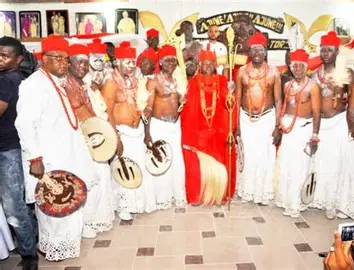
Urhobo Social Club members in chieftaincy regalia with the Ohworode of Olomu
Urhobo Social Club members in chieftaincy regalia, honoured by the late Ohworode of Olomu Kingdom in January 2017.
A Living Link

The Club and the Thrones

For the Urhobo Social Club Lagos, the kingdoms are not an abstraction. In January 2017 the late Ohworode of Olomu Kingdom, HRM (Dr) Richard Ogbon, OON, Ogoni-Oghoro I, conferred chieftaincy titles on nine members of the club: a living bond between the club in Lagos and a throne at home.

The full honour roll, and the regalia it brought, are told on our Culture page.

The chieftaincy story on the Culture page

About this page & sources

This page draws on the scholarship of Peter Ekeh and the Urhobo Historical Society (waado.org), Obaro Ikime's biography of Mukoro Mowoe, and Nigerian press reporting including Vanguard, The Guardian, Punch, The Nation and Urhobo Today. The count of the kingdoms is genuinely contested and is presented here as a range. On Okpe: the Okpe Union maintains that the Okpe are a distinct nationality; this site follows the Urhobo Progress Union, mainstream scholarship and the reigning Orodje in counting Okpe among the Urhobo kingdoms. Facts about reigning monarchs are stated as of June 2026. Corrections and contributions from the community are warmly welcomed through our Contact page.

Carry the Heritage Forward

The Urhobo Social Club Lagos preserves our culture and invests in our people. Join us, or support the building of Urhobo House.