Deep Antiquity
Origins in the Niger Delta
The Urhobo emerge as a people of the western Niger Delta. Oral tradition links their origins to migrations from the area of the ancient Benin Kingdom, with the people moving in successive groups, each settling at its own pace.
c. 14th Century
The Oldest Kingdoms
Ughelli and Agbon, regarded as among the oldest Urhobo kingdoms, are traced in tradition to roughly the fourteenth century.
17th Century
Okpe Kingdom Formalised
The Okpe Kingdom, often described as the largest Urhobo sub-group, is recorded as having been formally established in the seventeenth century.
3 November 1931
The Urhobo Progress Union is Born
Founded in Warri as the Urhobo Brotherly Society, to foster unity and fellow-feeling among the Urhobo, with Chief Omorohwovo Okoro, Chief Mukoro Mowoe and Thomas Erukeme among its founding officers.
1935
A New Name
The body adopts the name it carries to this day: the Urhobo Progress Union (UPU).
1937
Mukoro Mowoe Leads
Chief Mukoro Mowoe becomes President-General of the UPU, the towering Urhobo leader of the early twentieth century.
1948 – 1949
Urhobo College Founded
The UPU establishes Urhobo College, with its first students resuming in January 1949, a milestone in the union's championing of education.
1956
"Unity is Strength"
The UPU motto changes from "Higher Aims, Higher Thoughts" to the enduring "Unity is Strength."
3 April 1971
A Dinner at the Federal Palace
Prominent Urhobo sons honour Major-General David Ejoor, newly appointed Chief of Army Staff, at a dinner in Lagos. Moved by the occasion, Senator Joseph Sarwuan Tarka launches the Major-General David Ejoor Petroleum Fund, a scholarship initiative.
1973
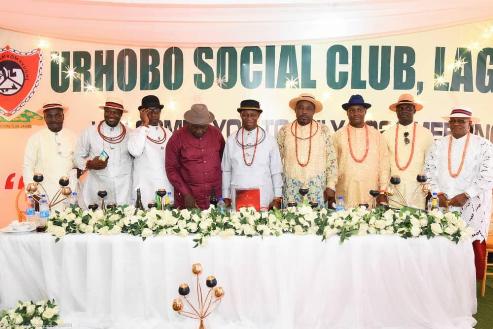
The Urhobo Social Club Lagos is Founded
To carry forward the fund and the fellowship around it, the Urhobo Social Club, Lagos is formally established. Its pioneer President is Chief Isaac Innocent Iyeyemi and its pioneer Secretary Chief Oghwe William Ikpasa.
2017
The Vision of Urhobo House
At a leadership transition, Prince Austin Enajomo-Isire pledges to build a clubhouse, Urhobo House. The club had acquired land at Abijo GRA, Lekki, for the project, with the inauguration drawing leaders of the wider Urhobo nation.
2025 – 2026
More Than Fifty Years
The club marks over five decades since its 1973 founding, reaffirming its commitment to the Urhobo Progress Union, to unity, and to completing the Urhobo House building project in Lagos.