For the Urhobo, history lives in memory and the spoken word. This is the archive of the voice: the keepers who carry it, the knowledge it holds, and an invitation to add your own.
Much of Urhobo history, moral philosophy and cosmology lives not in archives but in memory, carried in the Urhobo language from one generation to the next.
Pre-colonial Urhoboland produced no indigenous script, so the record was kept and passed on by voice: in the founding narratives each kingdom remembers, in proverbs and riddles, in folk songs and the satirical Udje, and in the rituals of the festival year. These accounts differ from one community to another, and that is part of their richness, not a fault. As the scholar Peter Ekeh observed, the variation reflects a people organised not as one centralised state but as a federation of self-governing kingdoms.
Today language shift and the move to the cities thin this inheritance, which is why a record like this one matters, and why we ask the community to help us keep it.
Before writing, memory was held by the people and offices entrusted to keep it.
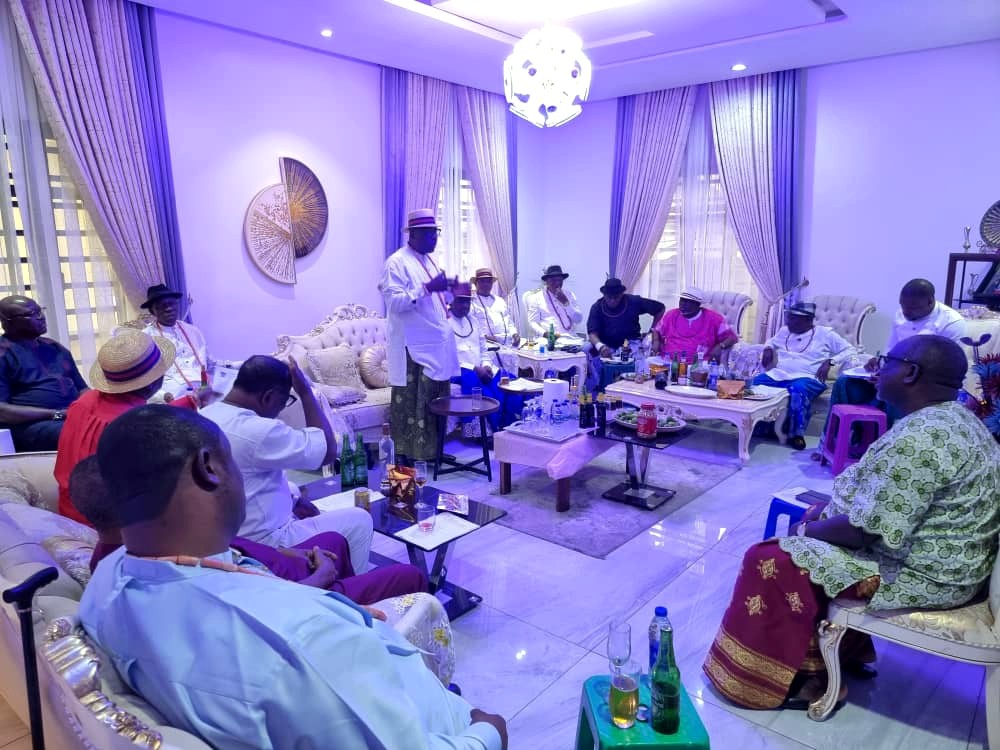
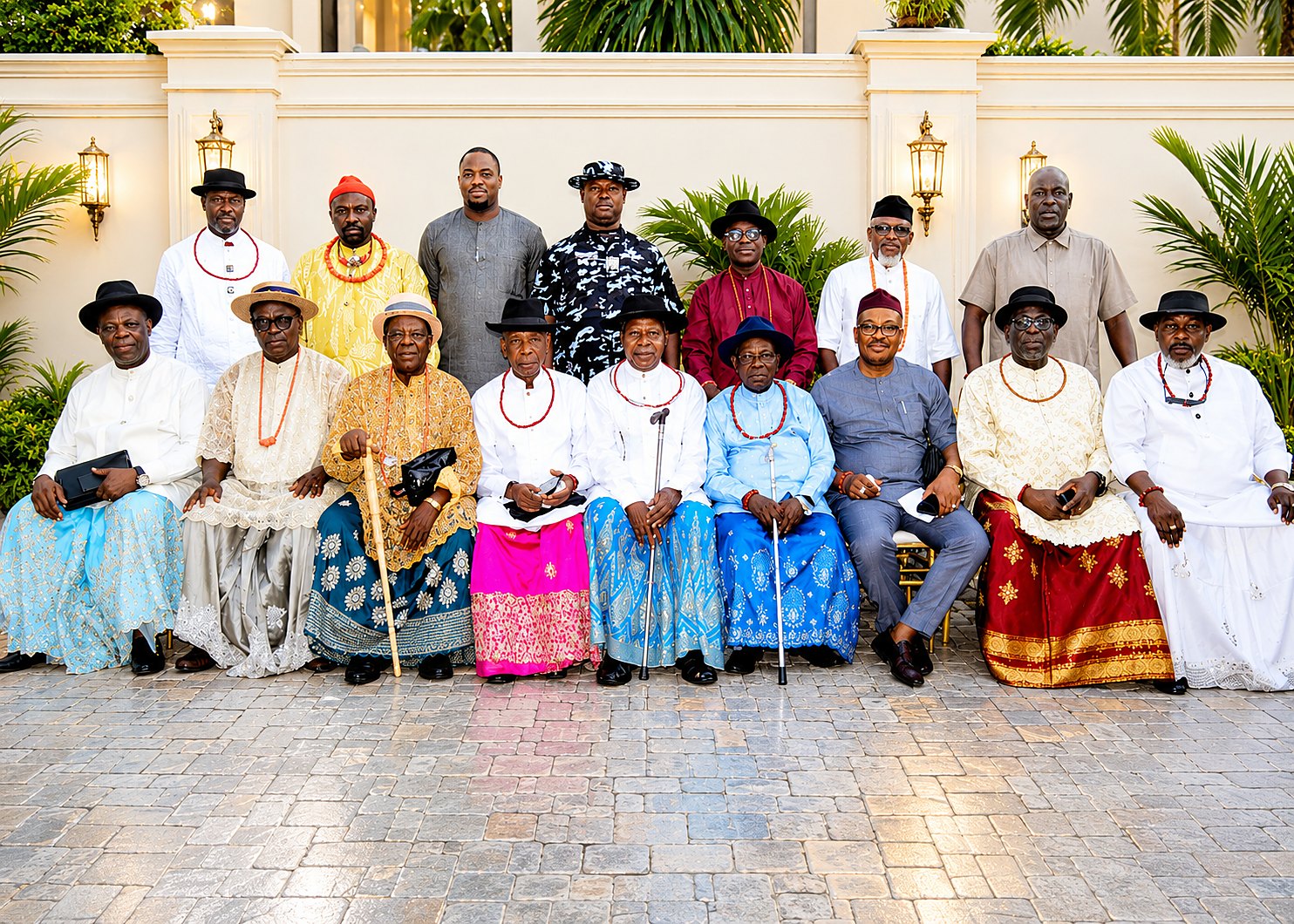
In Urhobo society, age, oratory and a sound knowledge of custom confer standing. The carriers of memory are both people and offices: the council of elders that guards the record, the spokesman who must know the history in order to speak it, and the priest who keeps the protocols of the sacred groves. The festivals carry their share too, staging the old knowledge anew each year. You can follow that thread on our Festivals & Celebrations page.
Men advance through age-grades, and the senior grade, the Ekpako, sits as the council that holds custodial authority over history, custom and judgement. The grades are most often given as Imitete, Otuorere, Ivwragha and Ekpako, though the names and bands vary from kingdom to kingdom.
The spokesman of the community is required to know its history and oral literature and to deploy that knowledge in public oratory. To speak for the people, the Otota must first remember for them.
The hereditary priest keeps the spiritual protocols of the sacred groves and the tree-taboos, passing on the rules that bind the community to its land.
Urhobo names carry meaning, many of them theophoric, broadly meaning that God has done it or that God is worthy of praise. Explained within the family, the naming is itself a lesson in belief and memory.
Much of the oral tradition is a covenant with the land, held as a spiritual duty.
For the Urhobo these are first of all matters of the spirit: groves, trees, animals and waters bound to the deities and the ancestors, honoured through taboo and rite. That the same observances also guard the forest and the fish is a truth scholars name as conservation, but in the community it is lived as obligation, not policy.
Many communities keep a grove left undisturbed and protected by taboo. To fell a tree there needs permission, and to break the rule invites ritual sanction. The Osedjo and the elders pass these protocols on.
Certain trees are held holy: the Okpagha, associated with the deity Aziza, around whose mature stands streams are often found; and the Akpobrisi, held untouchable, whose deity is said to own the land around it.
Some clans will not hunt particular animals, holding them in a totemic bond. Among the Orogun people, the iguana is honoured in this way.
Narratives of the water spirits mark the seasons of fishing and the places to keep away from, tying belief to the daily livelihood of a riverine people.
Two of the great oral threads have their own homes in this archive.
Every kingdom keeps its own account of where it came from. Three broad traditions coexist across Urhoboland: a migration from Benin, an account that the Urhobo were always here, and a tradition tracing to Ile-Ife. None is settled by record. Ughelli, for instance, remembers its ancestor Ughene as a son of the Benin prince Oghwoghwa, a story not shared by all.
The best-documented Urhobo oral art is Udje, the satirical song in which rival quarters compose exaggerated verses about one another. In a society without prisons, the song corrected the community and kept its memory, an art studied by Tanure Ojaide and G. G. Darah.
The Urhobo are a proverb-rich people. Linguistic scholarship recognises the Urhobo proverb as a portable lesson in law and morality, used by elders in teaching, in raising children and in settling disputes, and passed cyclically from one generation of elders to the next.
We have chosen not to print specific proverbs or folktales here yet. The Urhobo language is tonal, and a mis-spelt or mis-toned proverb would do the tradition a disservice, so each will be set down only once a native speaker and elder has verified it. That care is part of the work.
The folktale record is honest about its gaps. The genres of folktale and riddle are well attested, but a full, faithfully transcribed and translated collection of Urhobo tales, and any distinctively named Urhobo trickster of the kind other peoples are known for, are not yet established in the documented record we can verify. That absence is not a verdict on the tradition. It is the very reason this collection exists.
The Urhobo Social Club Lagos keeps this record as part of a wider family of Urhobo memory: the Urhobo Historical Society and its digital library and museum, the Urhobo Studies Association at Abraka, and community projects that have begun recording the language and its many dialects.
This collection is growing. If you hold a story, a recorded voice, a song, a proverb explained by an elder, a family naming history or a memory worth preserving, we would be honoured to receive it through our Contact page. Contributions are reviewed with community elders before they are published.
This page draws on peer-reviewed scholarship, including Tanure Ojaide and G. G. Darah on the Udje tradition, the Journal of West African Languages on Urhobo proverbs, and studies of Urhobo social organisation; on community-authoritative repositories such as the Urhobo Historical Society's waado.org and the Digital Library and Museum of Urhobo History and Culture; and on the reference volumes of Peter Ekeh, History of the Urhobo People of Niger Delta. Oral accounts vary from kingdom to kingdom, and the page flags where a claim is contested or where the record is incomplete. Corrections and contributions from the community are warmly welcomed through our Contact page.
The stories of our elders are a treasure that fades if it is not gathered. Share what you carry, and help build the archive of the Urhobo voice.